Klepton · Wireless current sensor
Rogowski current sensor: the consumption of every machine, no wiring.
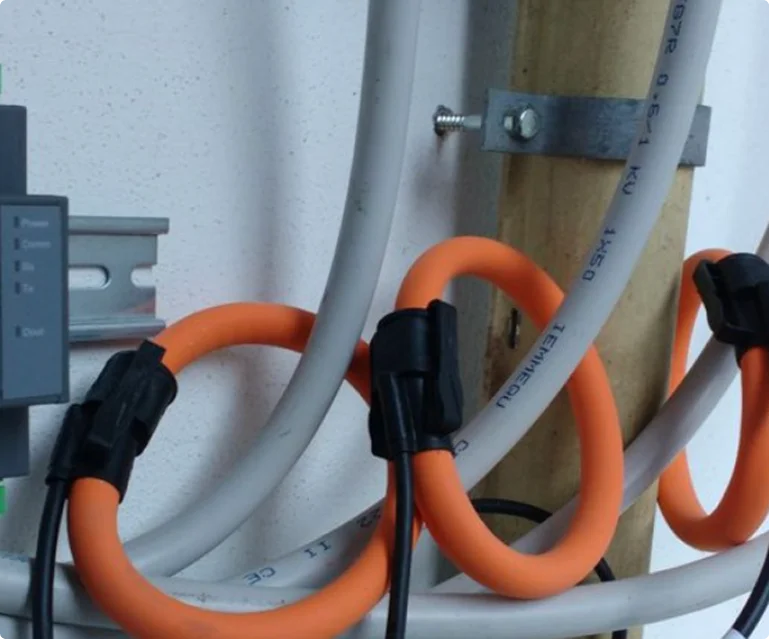
Klepton closes around the cable, with the line live, and measures current and energy of a single machine. No wiring and no battery: it is powered by energy harvesting from the current it measures.
- No wiring, no battery
- Closes around a live cable
- CE, FCC, UL508, IP30
The fee
Klepton pricing: three sizes, one monthly fee
The size follows the maximum current of the point you want to measure: a machine, a line, the main panel.
Base · 120 A
€25 / per sensor, per month
Up to 120 A. The size for a single machine.
Medium · 400 A
€35 / per sensor, per month
Up to 400 A. For department panels and large loads.
High · 1000 A
€40 / per sensor, per month
Up to 1000 A. For the main panel and large loads.
Prices exclude VAT, base API included in every fee. Device on loan, EOS platform, alarms and support are included. Connectivity is not included: Klepton uses the customer’s LoRaWAN® or WiFi network; where there is none, one or more Sintropy gateways are added, depending on the size of the spaces, at a separate fee. Single-phase or three-phase current and energy in kWh. The sensor closes around the cable with the line live; work inside the panel is done by a qualified electrician.
The sensor
Klepton technical specifications
If you are looking for a wireless current clamp, Klepton is a Rogowski coil: compact size, no wiring, no battery. CE, FCC and UL508 compliant, IP30 protection rating.
- Sensor
- Rogowski a coil that closes around the cable, with the line live
- Power
- From 2 A energy harvesting: powered by the current it measures, and stays on from 2 A
- Sampling
- 3 kHz maximum sampling rate
- Accuracy
- ±1 % on all three sizes: 120, 400 and 1000 A
- Measures
- A · kWh single-phase or three-phase current and energy
- Radio
- LoRaWAN® LoRa / LoRaWAN®, or the site WiFi

Compatible with the standard
All three sizes transmit over LoRa / LoRaWAN®, or over WiFi as an alternative.
Comparison
Compared with wired meters and self-powered clamps
Drawing power from the measured current is not exclusive to Klepton: sensors with a split-core transformer do it too. The difference is in the sensor, a Rogowski coil, in the dual LoRaWAN® and WiFi radio, and in the fee, which includes the platform and the base API.
| Wired meter | Self-powered clamp | Klepton | |
|---|---|---|---|
| Sensor | Fixed solid-core transformer | Split-core transformer | Rogowski coil |
| Power | From the mains, with dedicated wiring | From the measured current | From the measured current |
| Installation | Panel de-energized and wired | Closes around the live cable | Closes around the live cable |
| Connectivity | Wired bus (Modbus) | LoRaWAN® | LoRaWAN® and WiFi |
| Data | To be integrated into a SCADA or BMS | On the maker’s platform, or to be integrated | In EOS, with the base API included |
| Cost | Purchase and installation | Hardware purchase | Monthly fee from €25, device on loan |
Sensor
- Wired meter
- Fixed solid-core transformer
- Self-powered clamp
- Split-core transformer
- Klepton
- Rogowski coil
Power
- Wired meter
- From the mains, with dedicated wiring
- Self-powered clamp
- From the measured current
- Klepton
- From the measured current
Installation
- Wired meter
- Panel de-energized and wired
- Self-powered clamp
- Closes around the live cable
- Klepton
- Closes around the live cable
Connectivity
- Wired meter
- Wired bus (Modbus)
- Self-powered clamp
- LoRaWAN®
- Klepton
- LoRaWAN® and WiFi
Data
- Wired meter
- To be integrated into a SCADA or BMS
- Self-powered clamp
- On the maker’s platform, or to be integrated
- Klepton
- In EOS, with the base API included
Cost
- Wired meter
- Purchase and installation
- Self-powered clamp
- Hardware purchase
- Klepton
- Monthly fee from €25, device on loan
As of today, Klepton is the only Rogowski coil sensor powered by energy harvesting.
In the field
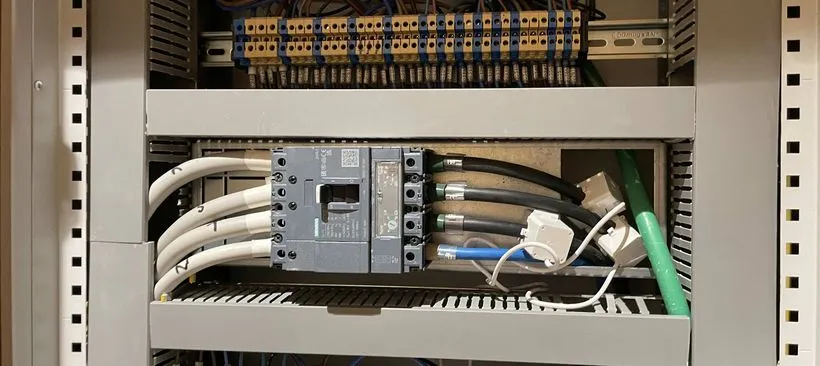
Klepton installed in an electrical panel
- The coil closes around the cable: nothing to cut, nothing to rewire.
- No power supply and no battery to plan for inside the panel; compact size.
- One sensor for every point you want to see on its own: machine, line, department, main panel.
How to start
Installing Klepton in three steps
Pick the points and the size
Decide which machines or lines you want to see separately and at what maximum current: 120, 400 or 1000 A.
The sensor closes around the cable
Your electrician closes the coil around the cable, with the line live. No wiring and no power to bring in.
See the consumption in EOS
Current and energy for that point reach EOS over LoRaWAN® or WiFi. History builds up shift after shift.
You can start with a few points and add more later.
FAQ
Frequently asked questions about Klepton
Do you have to de-energize the panel to install Klepton?
No. The Rogowski coil closes around the live cable without breaking the line. Work inside the panel is still electrical work: it is done by a qualified electrician.
How is a current sensor powered without a battery?
By energy harvesting: Klepton draws its power from the current it measures. It stays on and measures from 2 A of current on the cable. There is no power supply and no battery to replace.
How much current does Klepton measure, and how accurately?
Three sizes: up to 120 A, up to 400 A and up to 1000 A, all with ±1 % accuracy and sampling up to 3 kHz. It measures single-phase or three-phase current and energy in kWh. The size follows the maximum current of the point.
How does the consumption data reach me?
Over LoRa / LoRaWAN® or WiFi, depending on the site. Either way it lands in EOS, where you view and export it; with the base API included in the fee you take it into your own systems.
Contact
Order your first sensors
Tell us which points you want to measure and at what maximum current: we confirm the size, delivery and activation.
The details you leave are used only to get back to you about Klepton. We never pass them to third parties and delete them on request.
Prefer to talk? +39 328 399 3530
Email us sintropy-team@sintropy.ai
Sintropy is based in Milan. Hardware designed and built in Italy, support from the people who built it.
One sensor per machine, the consumption in EOS.
Order your first sensors: they close around the cable, with no wiring and no need to de-energize.